
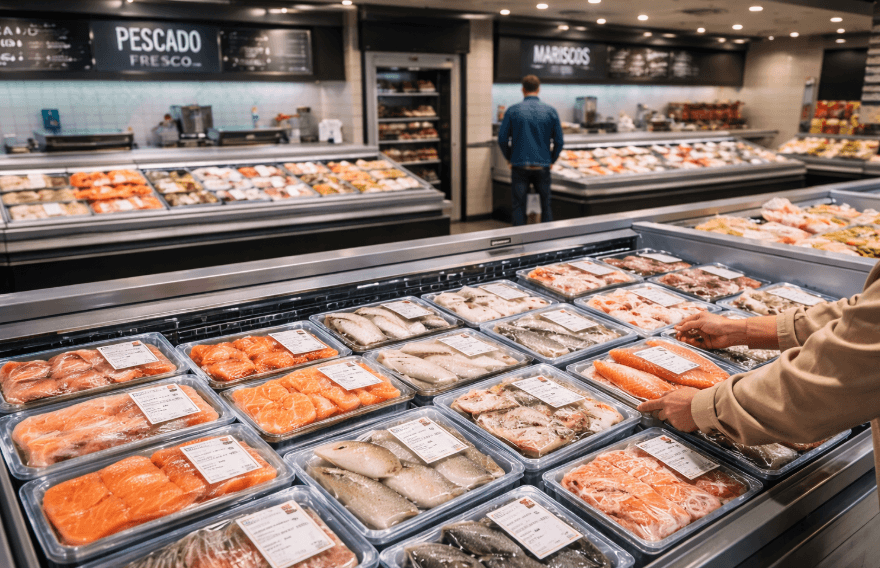
A major shift in how fresh food is sold is underway at Spanish supermarket chain Mercadona, as the retailer moves away from traditional fish counters toward pre-packaged, ready-to-cook products. The strategy reflects broader changes in consumer habits — trends that are also increasingly visible in Canada’s grocery sector.
A Shift Toward Efficiency in Grocery Retail
Mercadona has begun restructuring its fresh food sections by reducing or removing staffed fish counters in select stores. In their place, the company is expanding offerings of packaged fish that are cleaned, portioned and ready to prepare.
The move is part of its “efficient store” model, designed to streamline operations and improve productivity.
Retailers in Canada have adopted similar approaches in recent years, with major chains emphasizing convenience-driven formats such as pre-cut produce, ready-made meals and grab-and-go protein options.
Mercadona’s Position: Fish Isn’t Disappearing, Just Changing Format
Adapting to Modern Shopping Habits
The company maintains that fish as a product category is not being eliminated — only its presentation is evolving.
According to company sources, the goal is to better serve customers who prioritize speed and convenience. Pre-packaged fish allows shoppers to skip preparation steps and reduce time spent in-store.
Mercadona says the updated format offers several advantages:
- Improved product availability
- Shorter wait times for customers
- More efficient logistics and handling processes
This transition aligns with broader efforts to modernize store layouts and optimize operations across departments.
Market Trends Driving the Change
Declining Fish Consumption and Lifestyle Shifts
The decision also reflects wider market dynamics. In Spain, fish consumption has been declining for years due to rising prices, changing dietary habits and a growing preference for quick-to-prepare meals.
Similar patterns are emerging in Canada, where smaller households, busy lifestyles and increased demand for convenience foods are reshaping grocery purchasing behaviour.
Key trends influencing the shift include:
- Growth in single-person and smaller households
- Less time dedicated to cooking
- Rising demand for ready-to-cook or ready-to-eat products
In this context, traditional fish counters — which rely on skilled staff and customer interaction — are becoming less central to the shopping experience.
In-Store Impact: Less Service, More Self-Serve
A Different Shopping Experience
For customers, the changes are visible on the retail floor:
- Staffed fish counters are reduced or removed
- Refrigerated shelves feature a wider selection of packaged fish
- Store layouts are simplified for faster navigation
The shift also affects staffing, with fewer specialized roles required in-store. More processing is handled upstream, either by suppliers or distribution centres.
This mirrors changes seen in some Canadian supermarkets, where centralized processing has replaced in-store preparation in certain departments.
Consumer Debate: Convenience vs. Freshness
The transition has sparked mixed reactions among shoppers.
Some consumers welcome the convenience, appreciating the time saved and the ease of selecting pre-prepared products. Others, however, see the move as a loss of quality and personalization.
Traditional fish counters allow customers to choose specific cuts and seek advice from knowledgeable staff — an experience that packaged formats cannot fully replicate.
This tension reflects a broader debate in the grocery industry between efficiency and the perceived freshness or authenticity of food.
A Gradual Rollout With Room for Adjustment
Mercadona is introducing the changes تدريجياً across selected stores, suggesting the company is still evaluating the model before a wider rollout.
Future expansion will likely depend on factors such as customer acceptance, sales performance and operational gains.
What It Means for Shoppers
The shift signals a larger transformation in food retail: fewer staffed service counters and a growing emphasis on standardized, ready-to-use products.
For consumers, fish will remain available — but increasingly in formats designed for speed and convenience rather than traditional service.
As grocery habits continue to evolve in Canada and globally, the balance between efficiency and customer experience is likely to remain a central issue for retailers.

Carlos Ruiz Zafón fue uno de los escritores españoles más exitosos de las últimas décadas. Conocido por La sombra del viento, cautivó a millones de lectores con historias llenas de misterio, emoción y amor por los libros.