
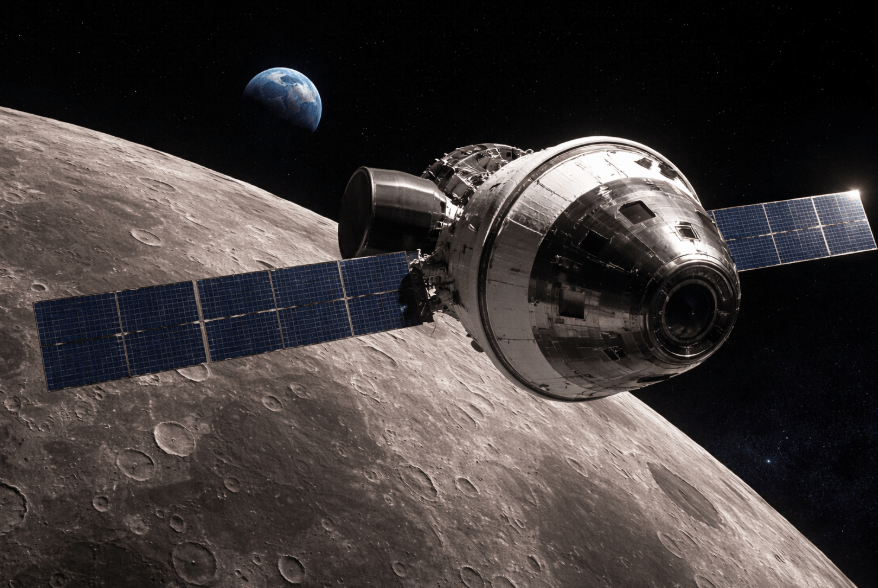
In a major milestone for human spaceflight, NASA’s Artemis II mission has successfully carried astronauts to the far side of the Moon, marking the furthest distance humans have ever travelled from Earth. The mission includes a Canadian astronaut, highlighting Canada’s growing role in deep space exploration.
Historic Lunar Flyby Pushes Human Limits
On the sixth day of the mission, the Orion spacecraft reached the far side of the Moon after launching last Thursday aboard NASA’s Space Launch System rocket from Kennedy Space Center in Florida.
The spacecraft made its closest approach to the Moon at approximately 6,530 kilometres above the lunar surface. Shortly afterward, it reached its maximum distance from Earth—about 406,772 kilometres—setting a new record for human space travel.
The crew includes NASA astronauts Reid Wiseman, Victor Glover and Christina Koch, alongside Canadian Space Agency astronaut Jeremy Hansen. Together, they have become the most distant humans from Earth in history.
Just before Orion passed behind the Moon—temporarily cutting off communications for roughly 40 minutes—Glover addressed those back home:
“Although we’re about to lose radio contact, we’ll continue to feel your support from Earth. To everyone down there and orbiting above it, we send our love from the Moon. We’ll see you on the other side.”
Life Aboard Orion: A Compact Deep-Space Journey
The four astronauts are travelling aboard Orion for a mission spanning roughly 1.1 million kilometres over 10 days. The spacecraft serves as both transport and living quarters.
The crew operates within a habitable space of about 9.3 cubic metres—comparable to the interior of two minivans. While compact, Orion offers nearly 60 per cent more room than the Apollo command module used during the Moon missions of the 1960s.
Astronauts live and work in the crew module, while the service module supplies essential life-support systems, including breathable oxygen, nitrogen and drinking water.
Before heading toward the Moon, Orion completed several orbits around Earth, followed by a four-day journey into deep space. After looping around the Moon, the spacecraft is scheduled to return to Earth 10 days after launch.
Precision Navigation and Suit Testing
On the fifth day of the mission, flight controllers in Houston and the crew executed a trajectory correction manoeuvre lasting 17.5 seconds to fine-tune Orion’s path toward the Moon.
That same day, astronauts completed a critical test of the Orion Crew Survival System suits. The evaluation included donning and pressurizing the suits, checking for leaks, simulating seat access, and assessing mobility, as well as the ability to eat and drink while suited.
These suits are designed to protect astronauts during high-risk phases of flight, including launch and re-entry, and to provide life support in the event of cabin depressurization or post-splashdown emergencies.
Entering Lunar Gravity
By the end of day five, Orion had entered the Moon’s sphere of influence—a point where lunar gravity becomes the dominant force shaping the spacecraft’s trajectory. This transition set the stage for the mission’s defining moment: the flyby of the Moon’s far side.
Return to Earth Planned in Pacific Waters
Following its lunar flyby, Orion will begin its journey back to Earth. Upon re-entry, the spacecraft will endure extreme heat and speed as it passes through Earth’s atmosphere before splashing down in the Pacific Ocean off the coast of San Diego.
Recovery teams from NASA and the U.S. Department of Defense will retrieve the crew and transport them safely back to shore.
A Milestone for Canada and Deep Space Exploration
Artemis II represents a significant step toward future crewed missions to the Moon and, eventually, Mars. For Canada, the participation of Jeremy Hansen underscores the country’s longstanding contribution to international space efforts, including robotics and astronaut training.
As the mission continues, Artemis II is laying the groundwork for sustained human presence beyond low Earth orbit—bringing a new era of exploration closer to reality.

Carlos Ruiz Zafón fue uno de los escritores españoles más exitosos de las últimas décadas. Conocido por La sombra del viento, cautivó a millones de lectores con historias llenas de misterio, emoción y amor por los libros.